
Grade 9 Health and Hygiene
Getting started
Look at the picture and discuss about the meaning of the health.

Looking at this word cloud, we can see that health is a rich, multidimensional concept that goes far beyond simply “not being sick.” The image beautifully captures how health touches every aspect of our lives.
Key Dimensions of Health
1. Physical Health
Words like fitness, training, athlete, muscle, body, running, and sport highlight the physical side of health. This involves:
- Regular exercise and physical activity
- Proper nutrition and diet
- Adequate rest and maintenance of the body
2. Mental Health
Terms such as mind, mental, relaxation, happiness, and cheerful remind us that health is also about psychological well-being:
- Managing stress through relaxation
- Cultivating positive emotions
- Maintaining emotional balance
3. Spiritual & Social Health
Words like spirit, wellbeing, nature, and enjoyment suggest that true health includes:
- A sense of purpose and inner peace
- Connection with nature and others
- Joy and fulfillment in daily life
4. Lifestyle & Habits
Lifestyle, hygiene, self-care, dieting, care, and healthy emphasize that health is built through:
- Daily choices and routines
- Personal hygiene
- Self-care practices
Health is not just the absence of disease, but a complete state of physical, mental, and social well-being — a definition consistent with the World Health Organization (WHO). It is a balance of body, mind, and spirit, achieved through conscious lifestyle choices, positive habits, and care for oneself and the environment.
In short, health is wealth — it is the foundation that allows us to enjoy life, pursue our goals, and live with happiness and purpose.
Reading I
Before you read the interview below, answer these questions.
- How do you get advice from a doctor?
There are several ways to get advice from a doctor:
a. In-person visit – Going directly to a hospital, clinic, or private practice for a face-to-face consultation.
b. Appointment booking – Scheduling a visit through phone calls, hospital websites, or health apps.
c. Telephone consultation – Calling the doctor’s office to ask quick questions or get medical guidance.
d. Online/Video consultation – Using video calls through apps like Zoom, WhatsApp, or specialized telehealth platforms.
e. Email or messaging – Sending health-related questions through email or patient portals.
f. Pharmacy referral – Sometimes pharmacists can connect patients with doctors for advice.
g. Health hotlines – Calling government or hospital health helplines for immediate medical advice.
2. What do you know about telehealth services?
Telehealth allows patients to consult with doctors, nurses, or specialists without visiting a hospital in person, using tools like video calls, phone calls, or mobile apps.
Common Services Offered
- Virtual doctor consultations via video or phone
- Online prescriptions and electronic medical records
- Remote monitoring of chronic conditions (e.g., diabetes, blood pressure)
- Mental health counseling and therapy sessions
- Follow-up appointments after treatment
- Health education and advice
Benefits
- Convenience – Get medical care from home
- Saves time and travel costs
- Access for rural areas – Helps people who live far from hospitals
- Reduces risk of infection – Especially useful during pandemics like COVID-19
- Quick consultations for minor health issues
Limitations
- Not suitable for emergencies or conditions requiring physical examination
- Requires internet access and digital literacy
- Privacy and data security concerns
- May lack the personal touch of in-person visits
Popular Examples
- Teladoc, Doctor on Demand, Amwell (international)
- Halodoc, Alodokter, Good Doctor (in Southeast Asia)
Telehealth has become increasingly popular, especially after the COVID-19 pandemic, and it represents the future of accessible healthcare.
The Acceleration behind Telehealth Services
(In this interview, Chun-Kai Chang , the Business Development Manager of Telehealth at Advantech, talks to News-Medical about the acceleration behind telehealth services.)
A. The meanings of some of the words from the interview are given below. Find the words and fill in the crossword puzzle.
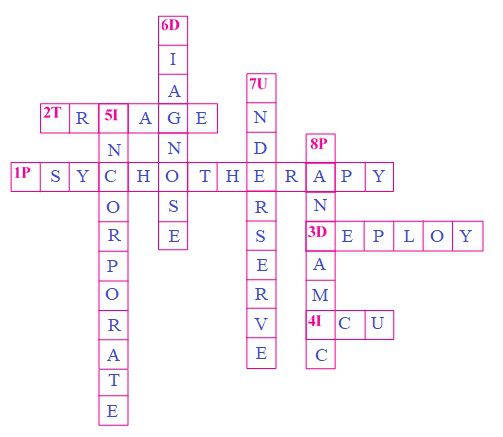
Across
1. psychological treatment of people using dialogue (PSYCHOTHERAPY)
2. process of sorting patients (TRIAGE)
3. to prepare and arrange (DEPLOY)
4. special department of a hospital for intensive care of patients (ICU)
Down
5. to include as a part (INCORPORATE)
6. identification of nature and cause of a disease (DIAGNOSE)
7. not having sufficient service (UNDERSERVE)
8. epidemic over a wide geographical area (PANDEMIC)
B. Read the interview again and write whether the following statements are True
or False.
a. Internet service is necessary to use telehealth services. (True)
b. While providing telehealth services, health professionals are at high risks of being infected due to the exposure to patients. (False)
c. Telehealth service can be the best alternative to a face to face service. (False)
d. The problem with the lack of medical staff will be solved to a great extent with telehealth technology. (True)
e. The success of telehealth programmes depends on the infrastructure and the best use of IT tools. (True)
B. Answer the following questions.
a. What is telehealth service?
Telehealth refers to delivering healthcare services from a distance, most commonly via video conferencing.
b. What are the advantages of using telehealth programmes?
The benefits of telehealth programs include being quicker, safer, more efficient, and more cost‑effective.
c. Why, according to Dr. Chang, is the telehealth service growing rapidly?
Dr. Chang states that telehealth service is expanding rapidly due to the global COVID‑19 pandemic, which required social distancing and limited physical contact.
d. How is the telehealth programme important during a pandemic?
During a pandemic, telehealth plays a vital role by enabling people to receive medical care from home, reducing the need for hospital visits and lowering the risk of infection for both patients and healthcare workers.
e. Why are the patients in remote areas not getting adequate health services?
People living in remote areas are not getting sufficient healthcare services due to inadequate (lack of) monitoring and follow-up.
f. Mention the top three challenges of telehealth services.
The top three challenges of telehealth services are lack of infrastructure, insufficient hardware, and the right technology for each specialty.
or
The main challenges of telehealth services include poor infrastructure, limited hardware resources, and the lack of suitable technology for different medical specialties.
D. How might rural communities feel about telehealth services? How could this be improved? Talk to your friends.
Rural communities may feel positive about telehealth services because they allow people to consult doctors without traveling long distances. This can save time and money and make healthcare more accessible. However, some people may feel concerned about poor internet connections, lack of devices, or limited technical knowledge.
Telehealth services could be improved by providing better internet access in rural areas, supplying necessary equipment, offering training on how to use telehealth platforms, and increasing the availability of healthcare professionals online. This would help more people receive quality healthcare services from their homes.
Pronunciation
Pronounce the following words with the help of your teacher or a dictionary.
Grade 9 Health and Hygiene
Speaking
A. Read and act out the following conversation.
Shanti : Ah, this is just ridiculous!
Selina : Sneha again?
Shanti : Yeah, Sneha. She just keeps asking for money. What do you think I should do?
Selina : Well, if I were you, I’d ask her not to beg.
Shanti : I’m not sure that’s a good idea.
Selina : Umm.., I’m not sure then. Perhaps you should try talking to Sneha about it.
Shanti : Well, I’ve tried that. But she did not show any interest.
Selina : How about talking to her parents?
Shanti : Really? I’m not too sure about that. It might work, I suppose.
B. How does the woman advise the girl?
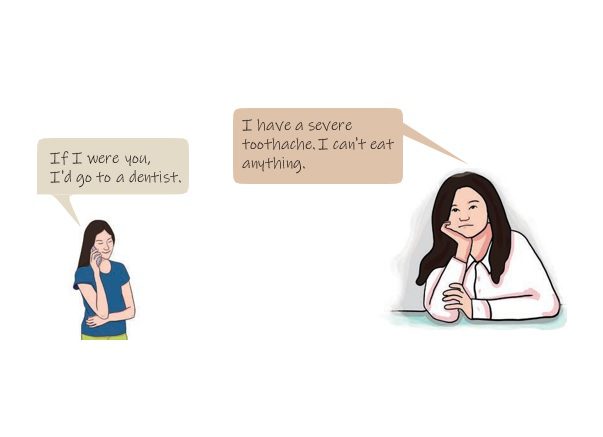
Now, work in pairs and take turns to explain your situation and give suggestions.
a. A: tired/ not sleep | B: | have a hot drink |
b. A: cold/ no heating | B: | put a sweater on |
c. A: friend’s birthday/ no money | B: | pick a bunch of flowers |
d. A: hurt my leg | B: | go to see a doctor |
e. A: not feeling well | B: | take a rest for a while. |
Pair Work: Situations and Suggestions
a.
A: I’m tired because I didn’t sleep well last night.
B: If I were you, I’d have a hot drink.
b.
A: I’m feeling cold because there is no heating.
B: You should put a sweater on.
c.
A: It’s my friend’s birthday, but I don’t have any money for a gift.
B: How about picking a bunch of flowers?
d.
A: I have hurt my leg.
B: You should go and see a doctor.
e.
A: I’m not feeling well.
B: If I were you, I’d take a rest for a while.
A. Give suggestions in the following situations. Use the given expressions.
a. She struggles in English although she works very hard.
b. She has lost her maths book in school.
c. She has put on weight, but she wants to be slim.
Answer:
a. She struggles in English although she works very hard.
i.You’d better ask your English teacher for extra help.
ii. If I were you, I would practise speaking English every day.
iii. Why don’t you join an English-speaking club?
iv. You should/ought to read simple English books regularly.
v. If I were you, I would watch English programmes with subtitles.
b. She has lost her maths book at school.
i. You’d better report it to your maths teacher.
ii. If I were you, I would check the lost-and-found office.
iii. Why don’t you ask your classmates about it?
iv. You should/ought to look for it in your classroom.
v. If I were you, I would ask the school staff for help.
c. She has put on weight, but she wants to be slim.
i. You’d better avoid too much junk food.
ii. If I were you, I would exercise regularly.
iii. Why don’t you go for a walk every day?
iv. You should/ought to eat a balanced diet.
v. If I were you, I would consult a doctor or nutritionist for healthy advice.
Grammar I
A. Study what the people in the picture are saying.
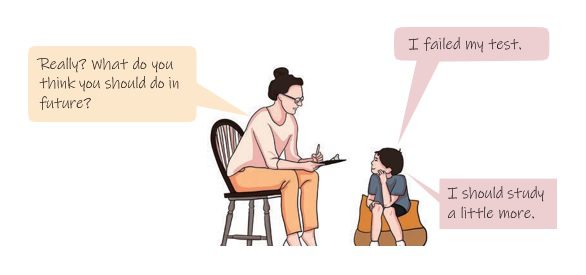
B. Choose the correct answer.
a. I need help, doctor. My baby doesn’t sleep well. What…………………. ?
i. had I better do ii. should I do iii. I should do
Explanation: Questions asking for advice use the structure: Question word + should + subject + verb.
b. The aeroplane only allows two pieces of luggage. You …………… pack too much or you will have to take it out at the airport!
i. had better not ii. better not iii. had not better
Explanation: The negative form of “had better” is had better not + base verb.
c. A: I think that the grade my teacher gave me on my test is wrong.
B: Really? You……….. to her after class today.
i. should to talk ii. ought to talk iii. ought talk
Explanation: “Ought” always requires to before the base verb (ought to talk).
d. It’s raining and I don’t want to get my dress wet. I.………………… an umbrella.
i. had better not take ii. had better to take iii. had better take
Explanation: “Had better” is followed directly by the base verb without “to” (had better take).
e. Dinesh loves chocolate, but he…………………………. too much or he will
put on weight.
i. shouldn’t eat ii. should eat not iii. should eat
Explanation: We use shouldn’t (should not) to advise against doing something that has negative consequences.
f. My mother isn’t feeling well, so I told her that she…………………… to
the doctor.
i. ought go ii. ought to go iii. ought
Explanation: The full structure is ought + to + base verb (ought to go).
g. A: It’s so hot.
B: You………………….. your jacket!
i. should take off ii. should put on iii. should to take off
Explanation: “Take off” means to remove clothing, which makes sense when it is hot. “Should” is followed by a base verb without “to”.
h. I’m going to visit your country. Where …………. if I want to go shopping?
i. should I go ii. I should go iii. ought to I go
Explanation: For question word questions, invert the subject and auxiliary verb (Where + should + I + go).
Writing I
This is Aayush, 14 years, from Biratnagar. He likes to sit on the sofa for hours every day, watching TV and eating a lot of snacks. Write a couple of paragraphs about him. You may use the guiding questions given below.
a. What is the problem with Aayush?
b. What should he stop doing to be healthy?
c. What should he start doing?
d. What advice would you give him to maintain a healthy life?
Answer:
Meet Aayush, a 14-year-old teenager from Biratnagar. Like many kids his age, he loves relaxing after school, but he’s fallen into a pretty unhealthy routine. He spends almost all his free time glued to the couch, watching TV and mindlessly munching on junk food. Because he barely moves throughout the day, he’s started gaining weight and constantly feeling tired. To get his health back on track, he really needs to cut down on processed snacks and stop spending so many hours sitting in front of a screen.
Instead of staying indoors all day, Aayush ought to get outside and start moving. Playing a game of football with his friends, going for a bike ride, or even taking a quick evening walk would make a world of difference. He should also try swapping out the chips and sweets for fresh fruit and water. If I could give him one piece of advice, it would be to start small—limit TV time to just an hour a day and find an outdoor activity he actually enjoys. Making a few simple changes now will help him feel much more energetic and stay healthy for years to come.
Reading II
Look at the picture and answer these questions.
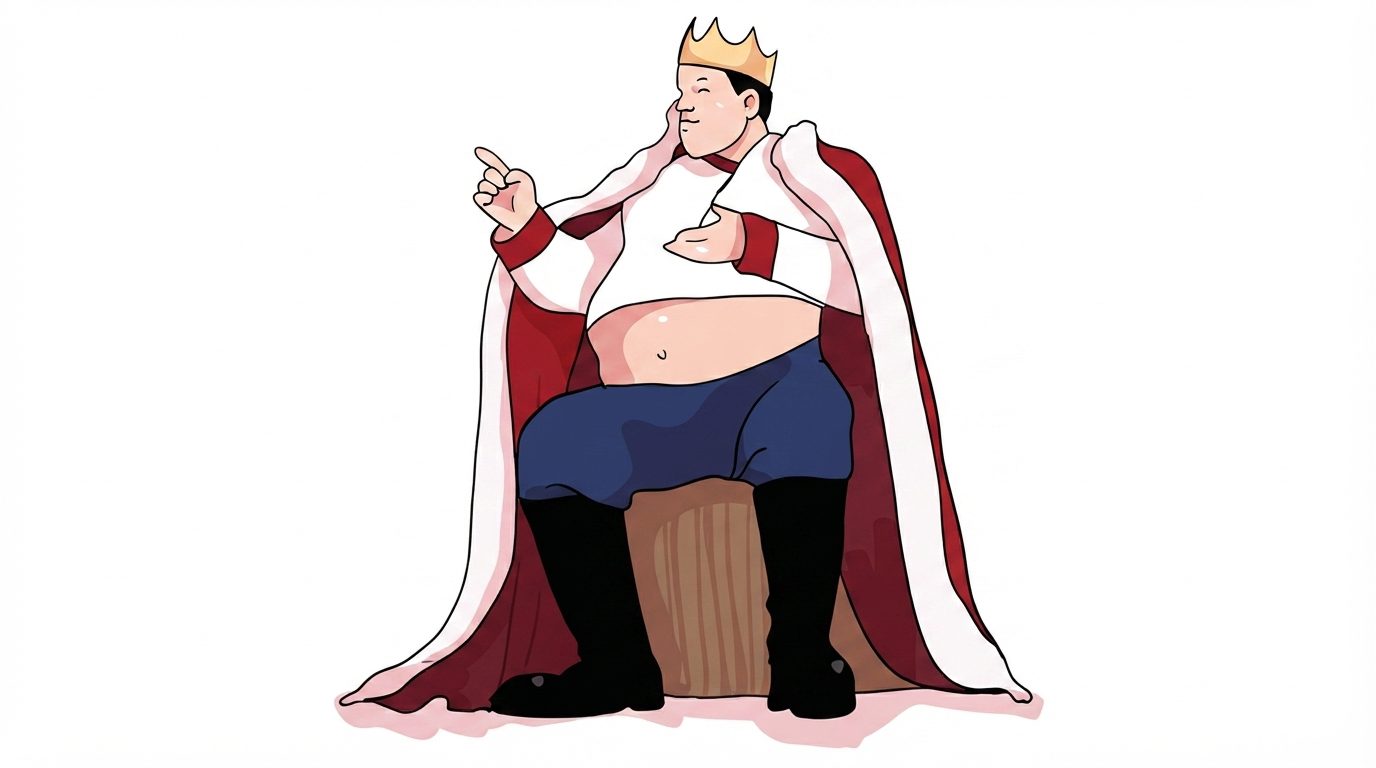
a. Who do you think the person in the picture is; a king or a wrestler? Why?
b. How has he put on so much weight?
c. Do you think he is healthy?
Answer:
a. The person in the picture is a king because he is wearing a gold crown and a royal cape.
b. He has likely put on so much weight due to overeating and a lack of physical exercise.
c. No, he does not appear healthy because his excessive weight suggests he is suffering from obesity.
Health is Wealth
A. Learn these words and complete the sentences with them.
a. ………….. can increase the risk of heart disease because obese people are likely to suffer from heart problems.
b. My father is kind, helpful and generous. He has a…………….. attitude.
c. Take rest for a week. Avoid tasks which require………………… physical activity.
d. I like God Shiva. I’m actually a…………………………………. of him.
e. My younger sister is a great…………………… She can watch TV 24 hours a day.
Answer
a. obesity
b. benevolent
c. strenuous
d. devotee
e. couch potato
B. Answer the following questions.
a. Why did people not like the king though he was kind?
The people did not like the king because he was extremely lazy and spent all his time eating and sleeping.
b. Why were the specialists called to the palace and offered huge prizes?
The specialists were called and offered large rewards in the hope that they could cure the king’s severe obesity and restore his fitness.
c. Why did the minister become so happy?
The minister became very happy because a visiting holy man promised that he could easily cure the king’s illness.
d. Why did the holyman tell the king to come to his place on foot for treatment?
The holy man told the king to come on foot so that the physical exertion of walking would force the king to exercise.
e. Why did the holyman disappear after the first meeting with the king?
The holy man purposefully made himself unavailable to trick the king into walking to his residence repeatedly over two weeks to ensure he got consistent daily exercise.
f. How did the king recover his health?
The king recovered his health by unintentionally exercising through his daily, strenuous walks to try and meet the holy man.
g. What lesson did you learn from the story?
The story teaches us that regular physical activity is essential for a healthy body, and that wealth cannot simply buy good health.
C. Retell the story to your friends, making the queen the main character.
Once upon a time, there lived a benevolent and kind-hearted queen. But the people weren’t happy with her because she was very lazy and would not do anything other than eating and sleeping. She spent days, weeks, and months on her bed either eating something or sleeping. The queen became a couch potato, and the people started to worry about her.
One day, the queen realised that she couldn’t move her body, not even her foot. She became very large, and her obesity became a matter of fun, with people calling her the ‘bulky queen.’ The queen invited expert doctors from various parts of her country and offered them generous rewards to make her fit. Unfortunately, none could help her gain her health and fitness back. The queen spent an enormous amount of money, but everything went in vain.
One fine morning, a holy man visited the country. He heard about the ill health of the queen and informed the minister at the palace that he could easily cure her. Hearing these promising words, the minister became very happy and requested the queen to meet the holy man to get rid of her problem.
The holy man resided at a distant place. Since the queen could not move her body, she asked the minister to bring the holy man to the palace, but the holy man refused. He said that the queen had to go to him in order to get cured. After strenuous efforts, the queen met the holy man at his residence, aided by her followers. The holy man complimented the queen, saying that she was a good ruler, and promised that she would soon regain her health. He asked her to come for treatment the next day, but told her she would be treated only if she came on foot.
The queen was unable to walk even a few steps on the road, but with the help of her followers, she reached the holy man’s place. Unfortunately, the holy man was not available, and his devotee requested the queen to come the next day for treatment. This was repeated for two weeks, and the queen never met the holy man and never had any treatment.
Gradually, the queen realised that she felt a lot lighter, had lost a considerable amount of weight, and felt more active than before. She finally understood the reason why the holy man had asked her to reach his place by walking. Very soon, the queen regained her health, and the people were very happy in her kingdom.
Listening
A. Look at the pictures and answer these questions.
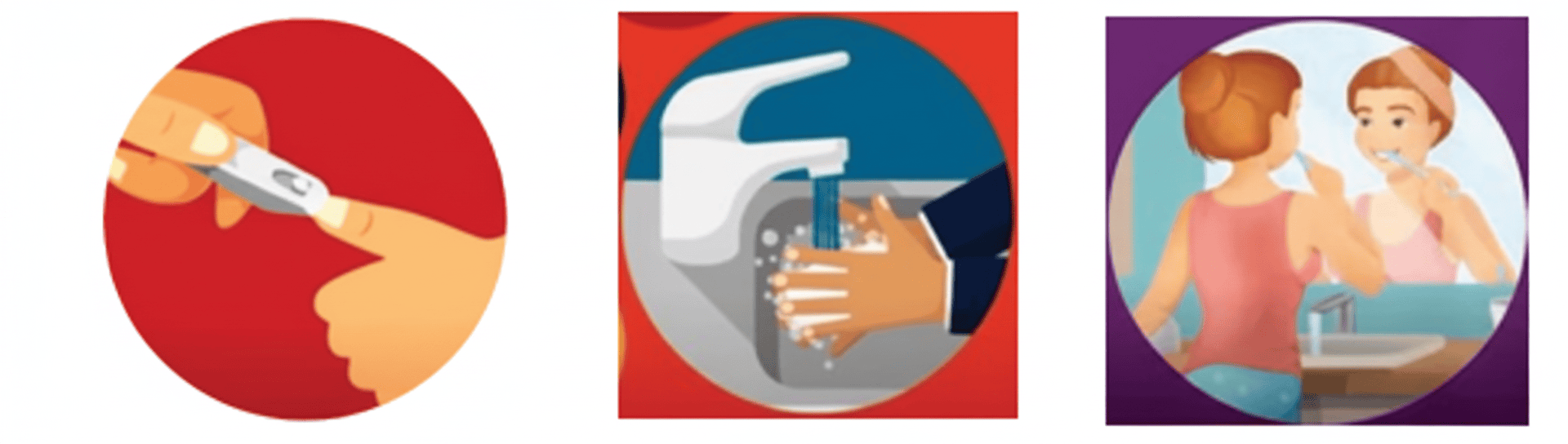
a. What do you see in the pictures?
First picture: A person is cutting their fingernails using nail clippers.
Second picture: A person is washing their hands with soap and water at a sink.
Third picture: A girl is brushing her teeth in front of a bathroom mirror
b. Do you regularly do these activities? Why?
Yes, I do all of these activities regularly because they are essential for good personal hygiene and health:
Cutting nails: I do this about once a week to keep my hands looking neat and to prevent dirt and bacteria from getting trapped under long nails.
Washing hands: I do this many times a day (especially before eating and after using the restroom) to kill germs and prevent the spread of illnesses.
Brushing teeth: I do this twice every day (in the morning and before bed) to prevent cavities, keep my gums healthy, and ensure fresh breath.
B. Listen to the audio and complete the following sentences choosing the correct answers.
Listening
Transcription from the Audio for Health and Hygiene
Personal hygiene involves taking care of our bodily health and well-being through cleanliness. It means that you bathe using soap and water every day and shampoo your hair regularly. Check your hair for any signs of lice and dandruff, and use a medicated shampoo if necessary. When it comes to grooming, always wear clean and washed undergarments, clean and ironed clothes, and a fresh pair of socks every day. Sweaty clothes or smelly socks bother other people around you, and also cause breeding of germs. Always remember to clean or polish your shoes. You must also brush your teeth twice a day, and floss once a day to avoid gum problems. Change your toothbrush every three months, and use a good quality toothpaste. Use natural mouth fresheners like green cardamom or fennel seeds to keep bad breath in check. It’s also very important to keep your nails clean and trimmed at all times, dirt can easily accumulate beneath long nails and cause bacteria to breed. Dirty nails not only look terrible but can cause food poisoning and other diseases too. Another very important thing to do is to wash your hands with soap and water before and after eating food, after using the toilet, and after coughing or sneezing, it’s a good idea to keep a hand sanitizer handy for when soap and water are not available. Let’s look at a scenario to understand the importance of good personal hygiene and grooming. Sam has recently joined a retail store in the sales department. He notices that customers approach him for queries, but they appear uncomfortable and then go to the next counter. Because of this, Sam’s sales are suffering. He approaches his friend Chris for advice. Chris, I am quite worried about not being able to make any sales. Customers come to me, but then they quickly go away without making a purchase. I think I know what the problem is. Um, apparently you haven’t been paying attention to grooming and hygiene. What do you mean? See, you haven’t shaved for many days, and it looks like you need a shower. Your body odor could be turning customers away. Um, actually, I had been keeping busy the last few days and didn’t have time to take a bath. Well, if you don’t shower or wear sweaty clothes, everyone can smell it, even from a distance, Sam. But what can I do if I sweat a lot and end up smelling even if I take a bath? You can use deodorant on your armpits every day after you shower, Sam. But remember to not use too much because the fragrance then gets too much and can make other people uncomfortable. Oh, I didn’t know that. Anyhow, now that you have seen how your lack of grooming and hygiene is affecting your work, you must promise yourself to take care of it. Thank you, Chris.
a. Personal hygiene means taking care of our bodily health and well- being through …………..
i. cleanliness ii. clearness iii. holiness
b. Dirty clothes and……………………… lead to the breeding of germs.
i. dirty hair ii. dirty shoes iii. smelly socks
c. We had better change the toothbrush every ……………………
i. month ii. two months iii. three months
d. Long and dirty nails can cause ……………
i. skin problems ii. food poisoning iii. dysentery
e. Sam works in the…………………………………. department.
i. sales ii. marketing iii. land
f. Sam hasn’t…………………… for many days.
i. combed his hairs ii. trimmed his nails iii. shaved
g. Kris suggests that Sam shouldn’t use ………. to get rid of his sweating problem.
i. deodorant ii. detergent iii. deodoriser